Lughnasadh: Celtic Roots, Unearthed
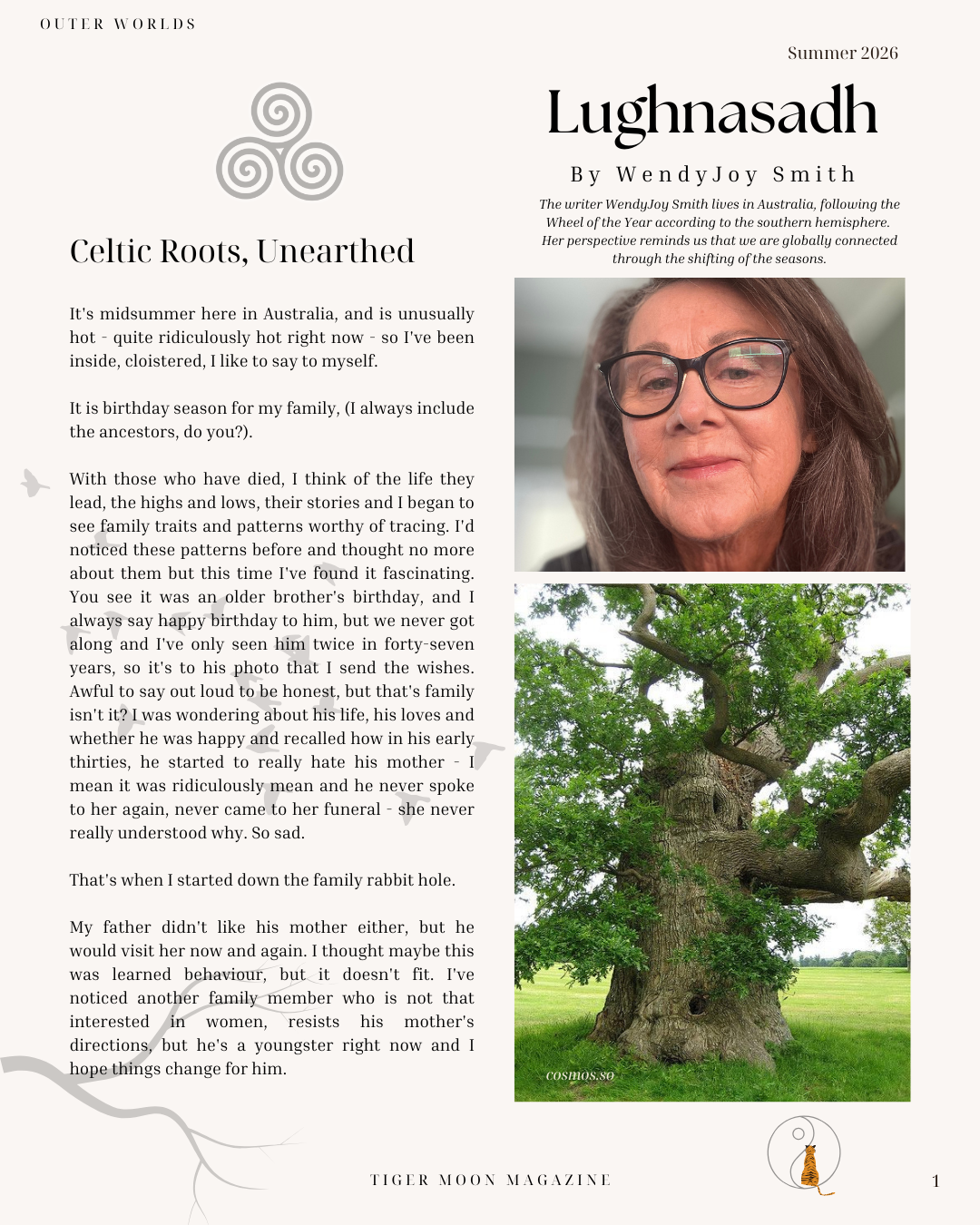
It's midsummer here in Australia, and is unusually hot - quite ridiculously hot right now - so I've been inside, cloistered, I like to say to myself.
It is birthday season for my family, (I always include the ancestors, do you?).
With those who have died, I think of the life they lead, the highs and lows, their stories and I began to see family traits and patterns worthy of tracing. I'd noticed these patterns before and thought no more about them but this time I've found it fascinating. You see it was an older brother's birthday, and I always say happy birthday to him, but we never got along and I've only seen him twice in forty-seven years, so it's to his photo that I send the wishes. Awful to say out loud to be honest, but that's family isn't it? I was wondering about his life, his loves and whether he was happy and recalled how in his early thirties, he started to really hate his mother - I mean it was ridiculously mean and he never spoke to her again, never came to her funeral - she never really understood why. So sad.
That's when I started down the family rabbit hole.
My father didn't like his mother either, but he would visit her now and again. I thought maybe this was learned behaviour, but it doesn't fit. I've noticed another family member who is not that interested in women, resists his mother's directions, but he's a youngster right now and I hope things change for him.
I began to plot it all on a chart and could clearly see hatred, abuse and jealousy and pondered on epigenetics. Epigenetics is an interesting science, it suggests many things such as trauma can be passed down, but it doesn't fit squarely with others who married into the family.
I then considered family curses. The Celts came to mind because I've been reading about the Irish author Jo Kerrigan who hails from West Corke, where my mother's paternal grandmother was born. Great grandmother kept her own book of recipes for food, but also for herb preparations and was known for her wisdom: I now wonder what else she knew about. My father's paternal grandfather was born in Belfast and was a story teller. My family hails from Celt countries.
I've come to realise many loved to curse back in the old days, but found the Irish had a fabulous way of praising and cursing, sometimes within the same breath according to family stories (that always brings a smile to my face).
The rabbit hole was getting deeper. I'd discovered the following traits:
Fathers not liking their first born sons:
four generations
Those who have married into the family:
three generations
Adult sons becoming estranged from their mothers:
three generations
Partner abuse, mostly delivered by men:
four generations
Two who married into the family, one a man, the other a woman (I could write a book on this one)
Jealousy
As far as the eye can see, can this be inherited?
Epigenetics or Curses? Does it matter? I see it as a curse if it goes back through as many generations as I have knowledge of, and where it could have ended, a family member has found a partner who enables it to carry on. (amazing)
Change Makers, The Black Sheep
two that I am aware of
Myself, plus another: We are the trait busters, the black sheep, the ones who do not accept the traits and say this ends with me.
I consciously said this out loud many years ago: my boys will not be abusers, my children will be guided and taught to be loving and this ends with me and I can say this has come to pass. I have three adult kids, but did the curse end there? Well, no it didn't. It would invade privacy to tell all, but the traits/curses have skipped and come via marriage, and so on we go.....things are now brewing in the next generation.
Neither learned behaviour nor epigenetics can explain that away, in my opinion, but curses can. The family line needs to be cleansed and set right for the future. It's hard to know where or why such things began, but I don't need to know and I turn to the ancients of the family I know, (the Celts) for clues.
The ancients would write curses on any surface they could find and pay to have them carried out by unseen forces; I cannot be sure of the efficacy but I know the power of healing and there are many studies now that prove the efficacy of prayer and healing.
The Celts were very dramatic (apparently they loved drama and the arts) and would bang down on the earth and call out to the sky. The backsmiths would turn the anvil one way or the other for curse or praise and the miller could make use of the mill stone. I chose prayer and ritual.
“Mystic forces, ancient and wise,
I ask you now to hear my cries.
Family curses and chains that bind,
Break them now and clear my mind.
With your power to cleanse the past,
Break the spells that long did last.
Elements four, earth, wind, fire, sea,
Break these curses and set us free.
Renew, transform, and restore,
Family curses exist no more.
So mote it be.”
My ritual will begin on the new moon for a lunar cycle. On the last day of the cycle I will light up the chart with the candle I had used, and scatter the ashes to the earth for loving transformation.
I feel the ancestors by my side. As a black sheep, I know deep within that this is one of the soul tasks I came here to take care of, and I am supported by their love.
February is the last month of summer, Lughnasadh approaches. In Celtic tradition, it was a time to come together to celebrate the fruits of the harvest and to give thanks for the bounty of the earth. For me this ending, this celebration of Lughnasadh will be especially heartfelt, it has been a summer to remember.
Wish me well dear friends.
References:
https://irishfolklore.wordpress.com/tag/irish-curses-magic/
https://www.healthcentral.com/condition/post-traumatic-stress-disorder/epigenetics-trauma