Tale from the trail: being and being seen
In June of 2023, I had just arrived in the Sierra foothills with my boyfriend, Chris, and our two cats at his family cabin. We moved from Florida and were in transition to the East Bay, utilizing the cabin as our refuge while our long-term plans began to root. Most of our experiences at the cabin thus far had been years prior: many one- and two-night stays, hiding away for a weekend that never seemed to last long enough. I was elated at the opportunity to spend multiple weeks immersed in a wilderness I had sought in Florida but could never quite grasp.
Purchased by the family in the late 90s, the cabin itself is beautiful in a rustic, nostalgic type of way: the kitchen cabinets still contain 1970s dishware from the original owners, included in the sale. The closets are filled with everyone’s winter jackets, after decades of bringing them up and leaving them behind, so that if you happen to forget yours, there are plenty to borrow. The master bedroom is large enough to include a secondary sleeping area for two small twin beds, a solution for housing more family members for the holiday traditions. The backyard has a large wooden deck that extends over a portion of the property, which is overgrown with native vegetation and fallen branches from the surrounding redwoods. From the deck, you can hear the gentle rhythm of a running brook that passes through the property. Chris tells me childhood stories of sitting by the brook for hours, eating sandwiches and reading comic books.
As soon as I opened the passenger-side door from the cabin’s driveway, my nose was instantly flooded with the scent of redwood needles.
With a tree not far away, I walked toward its branch and noticed a fresh extension of bright green needles from the end of a darker green branch—new growth. How strange that I’ve never noticed this before.
We unloaded our entire U-Haul into the garage and returned it to the local store, not knowing when we would need to acquire it again. We spent our mornings walking to the neighborhood lake, and I began noticing wildflowers for the first time. Difficult to ignore, their scent and beauty pull you into the art of noticing their presence. Since California is known for wildflowers, a few of the trails we went on included educational placards about which flowers you could find along the trail. This completely enticed me—a scavenger hunt for flowers? I couldn’t find anything like this in Florida.
Our evenings were spent applying to jobs online and scoping out potential cities and neighborhoods to live in. No strangers to moving, especially together, there was minimal stress involved in the logistics of moving itself. However, there were “logistical kinks”: the cabin did not have cell service, so if a prospective job called, we wouldn’t receive it. The cabin does have a landline, so I often found myself putting that as my phone number just in case, but that also created the issue of being home during office hours in order to catch a phone call. All of a sudden, we were in the 90s. Luckily, there was still an answering machine.
One afternoon, we decided to venture to a new trail area for the simple intention of decompressing. The warm June sun enveloped us along the open trail, and I felt as though the earth was embracing me in a warm hug. After growing up in Florida with 90%+ humidity, I could walk all day here in the blaring sun and barely break a sweat; it was lovely.
After only twenty or so minutes of walking, Chris and I happened upon a fair haired woman in complete trail gear. She seemed to be picking weeds along the edge of the trail and collecting them in her pocket.
“Hello,” we both said and smiled.
“Hi there!” she replied. “How are you today?”
“We’re doing great, just enjoying this sunshine,” Chris replied.
“Oh yes, it’s such a wonderful day. Are you here to see the lilies?” she asked.
Chris and I exchanged looks, then looked back at her and shook our heads.
“Lilies?” we both asked.
"The Humboldt lilies have just superbloomed further down the trail here,” she said, pointing into the distance towards direction we were headed.
“I can give you directions if you’d like,” she continued, but then changed her mind and said, “You know what, I can walk you there,” with a sweet smile.
We were thankful for her guidance, as neither of us were familiar with this trail, and it’s possible she noticed this.
“I’m a volunteer for this collection of trails. Some of us like to pick the invasive weeds along the trail so we can preserve the wilderness of the park,” she shared with us.
How is this happening? I thought to myself. Our very own wilderness guide.
“I like to collect the weeds in my pocket so I don’t lose any along the way. They self-propagate, so dropping one means so many more will grow in its place. I have to be careful,” she continued.
“The Humboldt lily self-propagates too; sometimes people come here to take their seeds home, but just remember they are protected here on this land,” she explained to us gently.
We reached a point in the path where she felt comfortable leaving us.
“Just continue forward a few hundred yards, and you can’t miss them. Enjoy!”
Seconds later, she passed around the bend, and we were alone on the trail once more.
“What a sweet lady,” we both agreed, and contemplated to each other what a Humboldt lily is. Only a few moments later, we were educated by Mother Nature herself.
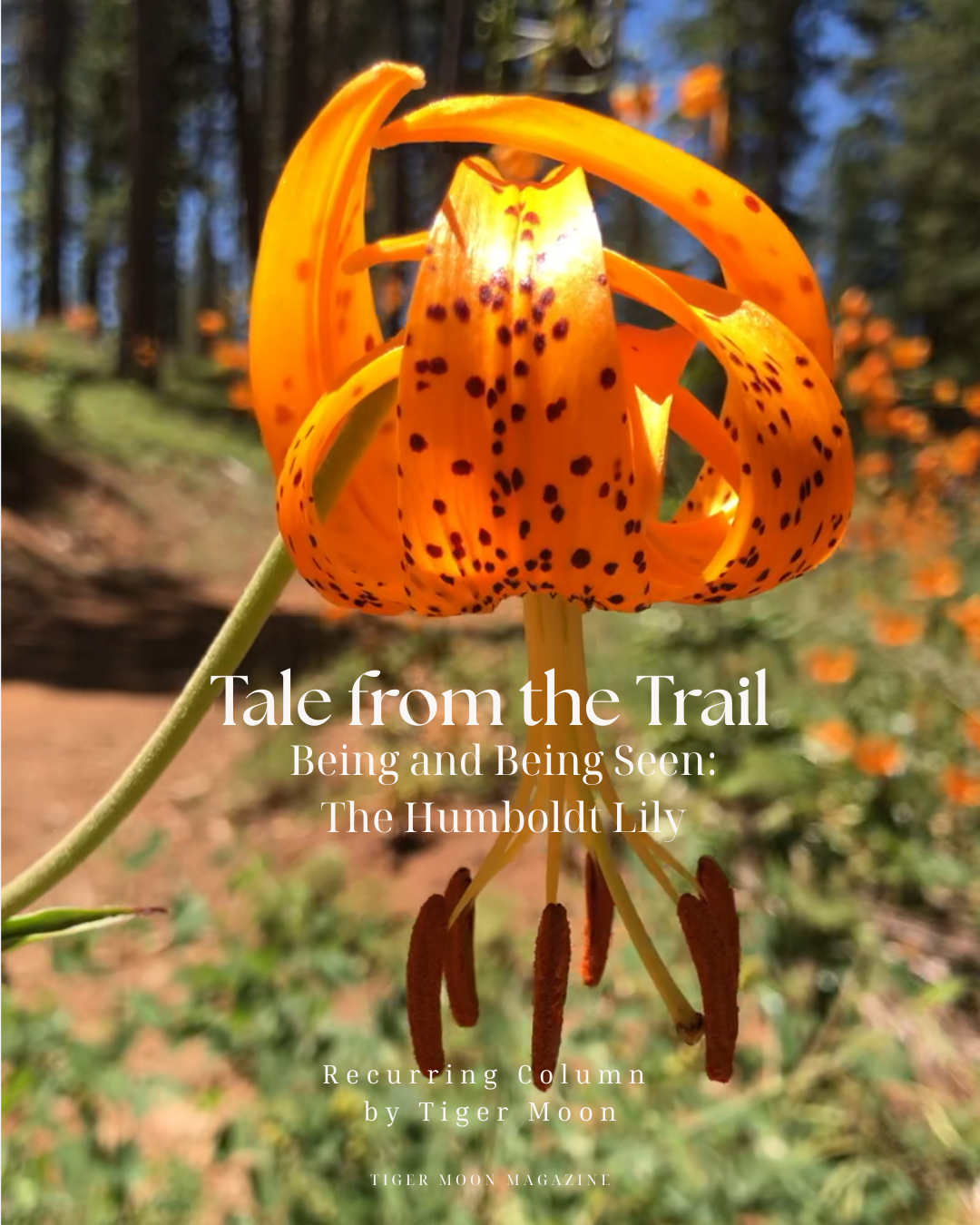
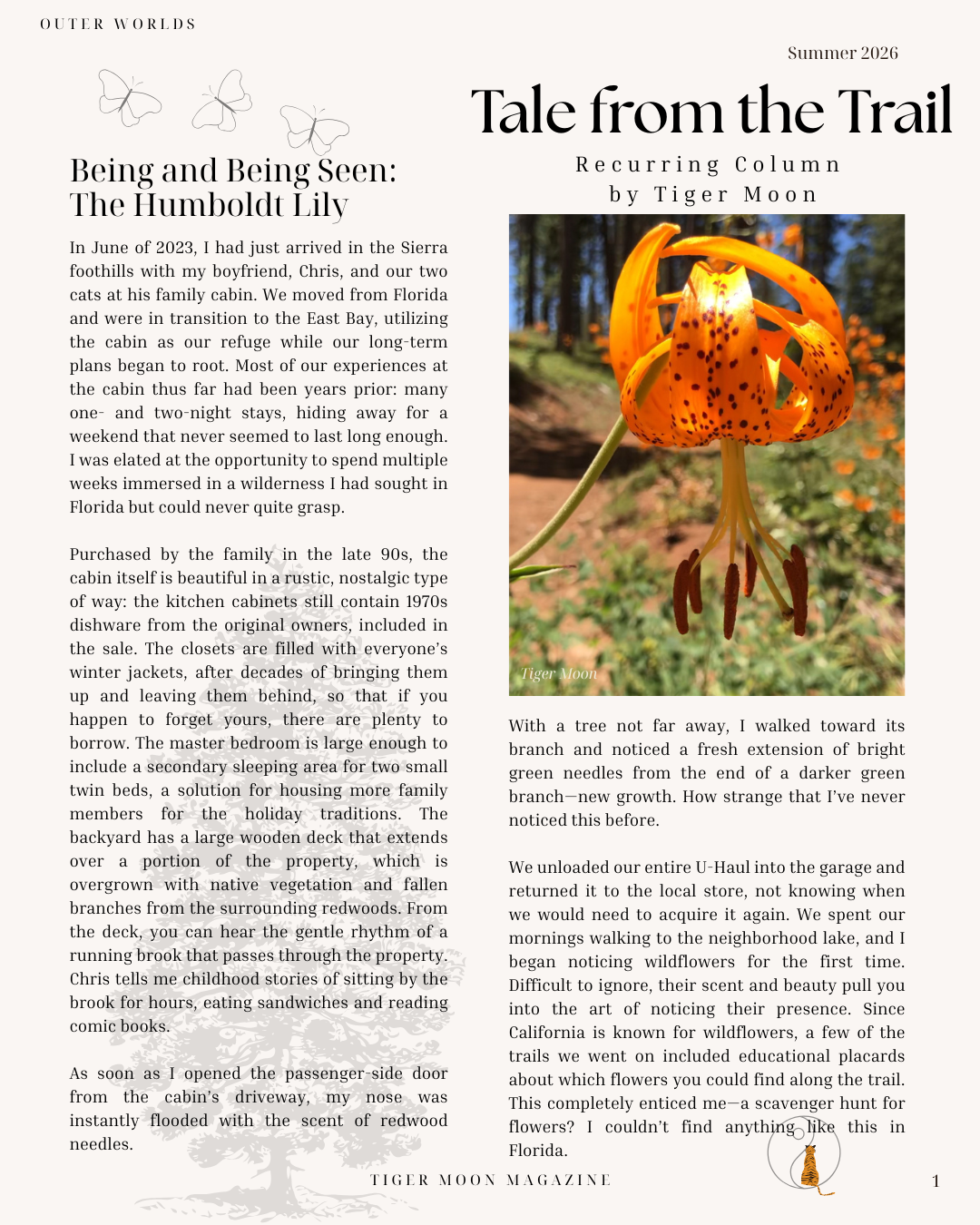
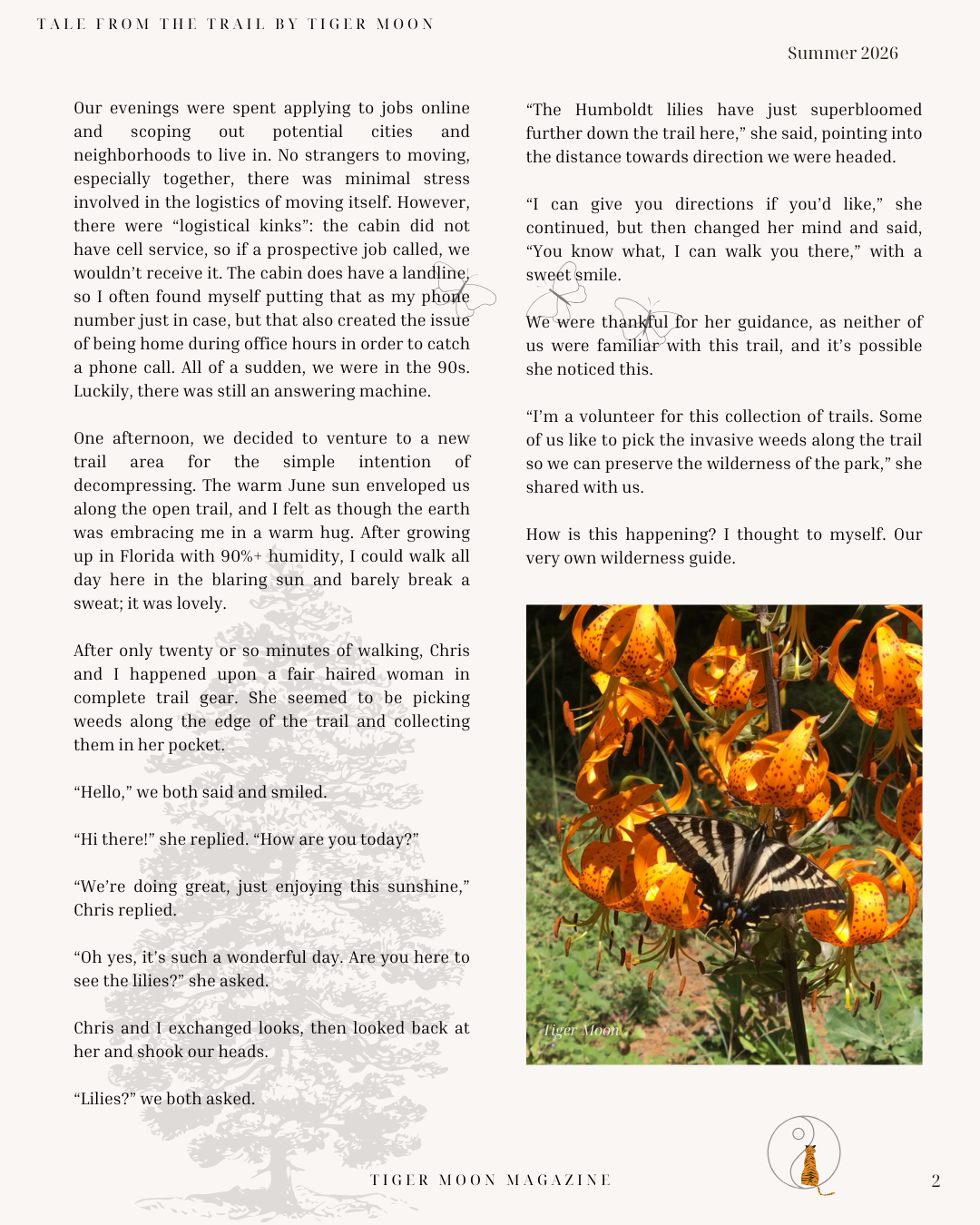
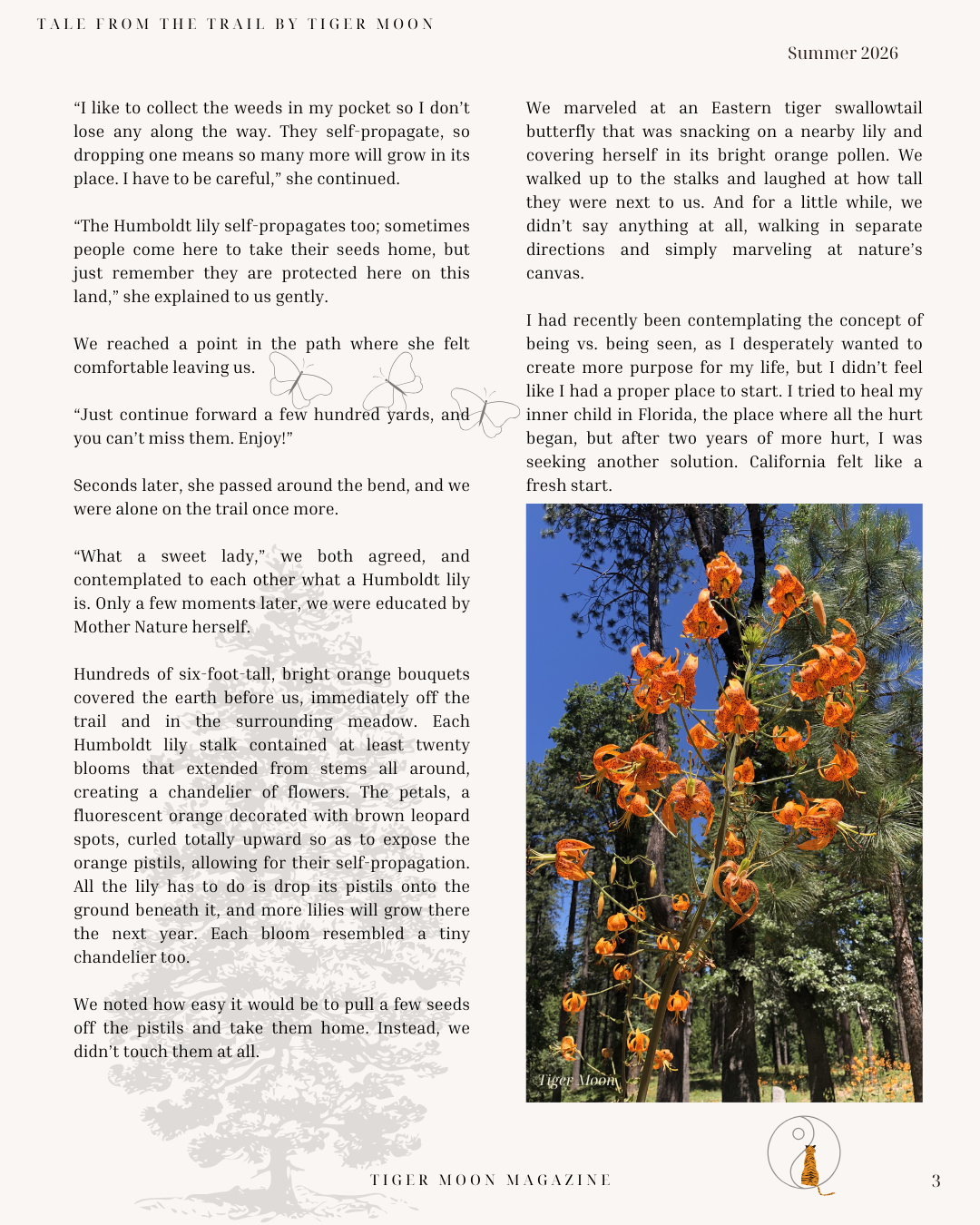
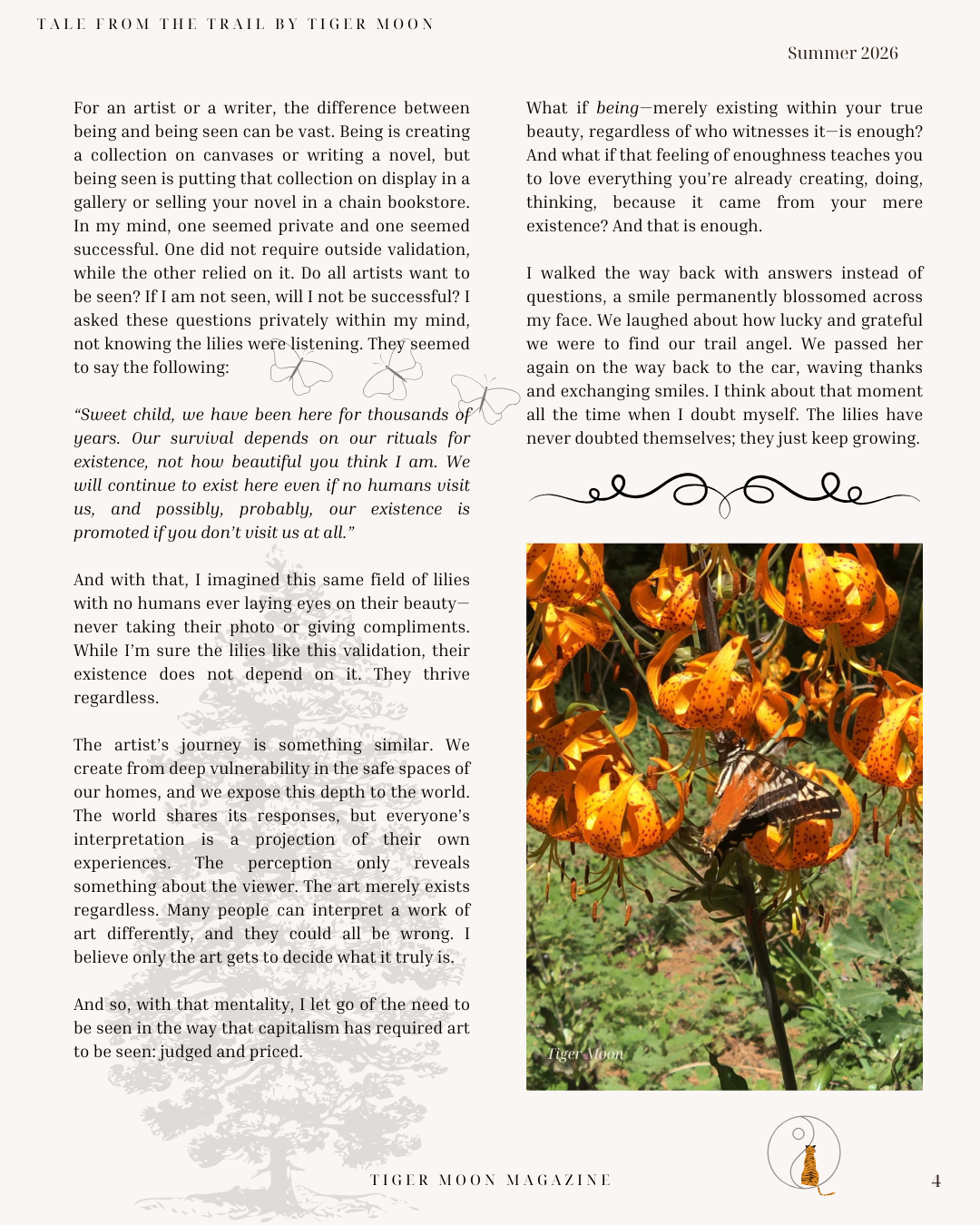
Hundreds of six-foot-tall, bright orange bouquets covered the earth before us, immediately off the trail and in the surrounding meadow. Each Humboldt lily stalk contained at least twenty blooms that extended from stems all around, creating a chandelier of flowers. The petals, a fluorescent orange decorated with brown leopard spots, curled totally upward so as to expose the orange pistils, allowing for their self-propagation. All the lily has to do is drop its pistils onto the ground beneath it, and more lilies will grow there the next year. Each bloom resembled a tiny chandelier too.
We noted how easy it would be to pull a few seeds off the pistils and take them home. Instead, we didn’t touch them at all.
We marveled at an Eastern tiger swallowtail butterfly that was snacking on a nearby lily and covering herself in its bright orange pollen. We walked up to the stalks and laughed at how tall they were next to us. And for a little while, we didn’t say anything at all, walking in separate directions and simply marveling at nature’s canvas.
I had recently been contemplating the concept of being vs. being seen, as I desperately wanted to create more purpose for my life, but I didn’t feel like I had a proper place to start. I tried to heal my inner child in Florida, the place where all the hurt began, but after two years of more hurt, I was seeking another solution. California felt like a fresh start.
For an artist or a writer, the difference between being and being seen can be vast. Being is creating a collection on canvases or writing a novel, but being seen is putting that collection on display in a gallery or selling your novel in a chain bookstore. In my mind, one seemed private and one seemed successful. One did not require outside validation, while the other relied on it. Do all artists want to be seen? If I am not seen, will I not be successful? I asked these questions privately within my mind, not knowing the lilies were listening. They seemed to say the following:
“Sweet child, we have been here for thousands of years. Our survival depends on our rituals for existence, not how beautiful you think I am. We will continue to exist here even if no humans visit us, and possibly, probably, our existence is promoted if you don’t visit us at all.”
And with that, I imagined this same field of lilies with no humans ever laying eyes on their beauty—never taking their photo or giving compliments. While I’m sure the lilies like this validation, their existence does not depend on it. They thrive regardless.
The artist’s journey is something similar. We create from deep vulnerability in the safe spaces of our homes, and we expose this depth to the world. The world shares its responses, but everyone’s interpretation is a projection of their own experiences. The perception only reveals something about the viewer. The art merely exists regardless. Many people can interpret a work of art differently, and they could all be wrong. I believe only the art gets to decide what it truly is.
And so, with that mentality, I let go of the need to be seen in the way that capitalism has required art to be seen: judged and priced.
What if being—merely existing within your true beauty, regardless of who witnesses it—is enough? And what if that feeling of enoughness teaches you to love everything you’re already creating, doing, thinking, because it came from your mere existence? And that is enough.
I walked the way back with answers instead of questions, a smile permanently blossomed across my face. We laughed about how lucky and grateful we were to find our trail angel. We passed her again on the way back to the car, waving thanks and exchanging smiles. I think about that moment all the time when I doubt myself. The lilies have never doubted themselves; they just keep growing.